
Every specs table on this site answers one platform at a time. This one counts across all of them. Our dataset holds 74 platform specs from 15 platforms, each researched from the platform's own help pages and recorded on September 13, 2026. The headline is how much agreement there is at the center, and how little there is at the edges: 10 of the 74 rows recommend exactly 1080x1920, the tall 9:16 frame, and only 6 rows record any safe zone at all.
The six surfaces everyone asks about
Searchers ask about the same six surfaces again and again: Facebook Stories, Facebook Reels, Instagram Stories, Instagram Reels, TikTok video and YouTube Shorts. Five of the six record exactly 1080x1920 in the dataset, which is why "facebook story size" and "instagram story dimensions" have the same answer. The sixth is the interesting one. TikTok's row records no recommended size at all, because TikTok's help center does not publish one. The 1080x1920 figure attached to TikTok everywhere else comes from third-party guides, not from TikTok, and the dataset leaves that cell empty rather than borrow it.
The full count of rows at exactly 1080x1920 is ten: the five surfaces above, plus Instagram's reel cover, Pinterest's video pin, and three Snapchat surfaces (Snap and Story video, Spotlight, and the single image or video ad). Ten rows, five platforms, one frame. If the dimensions agree this completely, the real differences have to live somewhere else, and they do: in the margins and the limits.
The same pixels, turned sideways
Five more rows recommend 1920x1080: YouTube's standard video, Vimeo uploads, Twitch stream output, Rumble uploads and the LinkedIn article cover. That is the same 2,073,600 pixels in landscape. Count both orientations and 15 of the 74 rows, one row in five, are built on the same pixel pair. The disagreement was never really about the frame. It is about everything the platforms wrap around it.
Safe zones: the number almost nobody publishes
Only 6 of the 74 rows record any safe zone figure. For the story and reel surfaces people actually ask about, exactly one publisher provides pixel margins: Meta, whose ad safe-zone guidance puts 250 pixels at the top and 250 at the bottom of Facebook Stories and Facebook Reels. Those margins come from Meta's advertising guidance, and the dataset labels them as such; they are the closest thing to an official number that exists for those surfaces. The most detailed safe zone in the whole dataset belongs to Pinterest pins: top 270, left 65, right 195, bottom 790. A Snapchat ad spec adds 150 pixels at the top and bottom, and a Discord server banner note reserves the top 48 pixels for the server title.
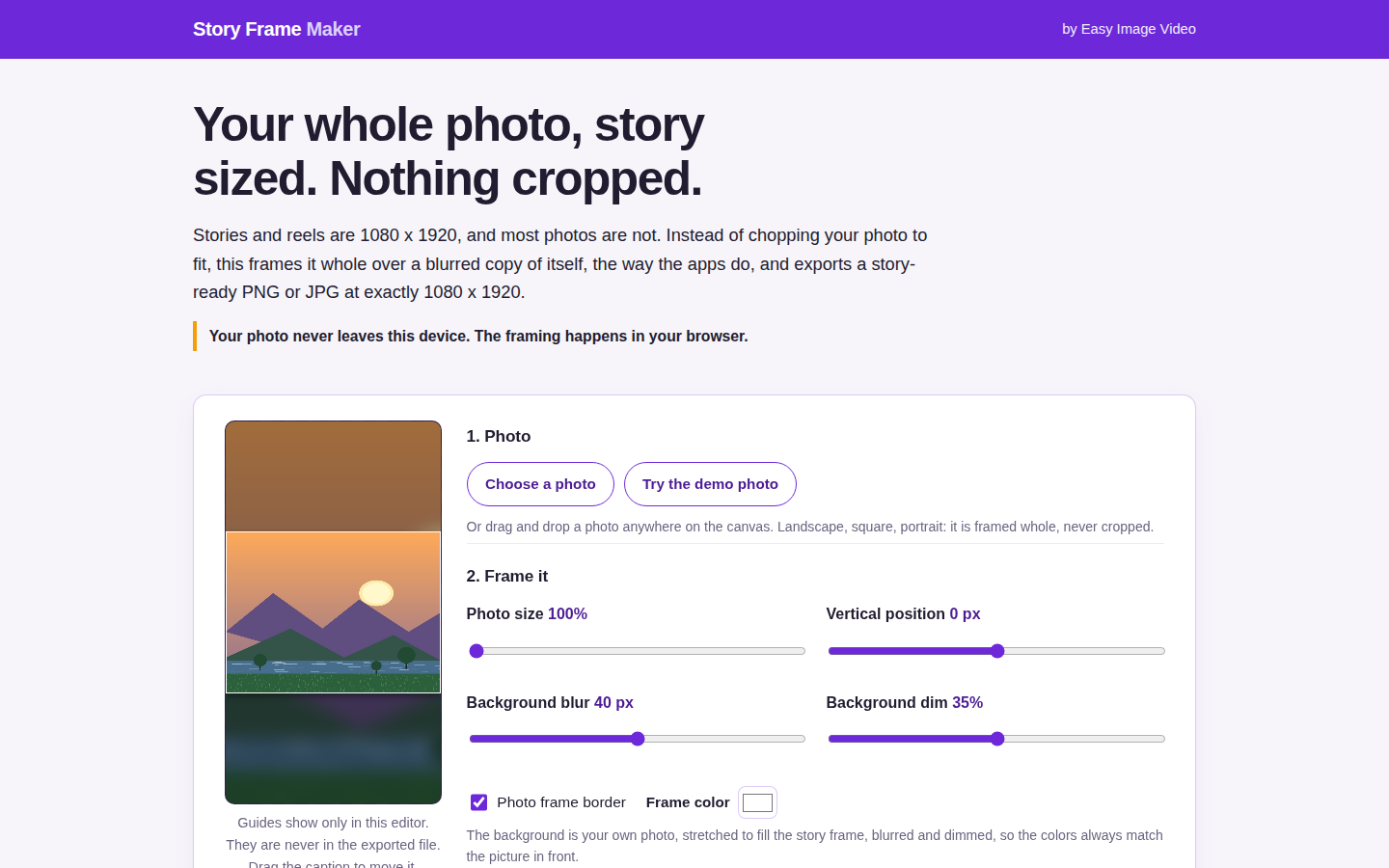
Instagram, TikTok and YouTube publish no official pixel margins for their tall surfaces. That gap is why the Story Frame Maker labels its TikTok and Shorts bands as editor guides rather than platform specs: they are drawn from where the apps put their buttons, not from a published number. For the checking routine itself, our frame checks post walks through all six checks on a real photo, and the Instagram story safe-zone guide carries that platform's sheet in full.
Same canvas, different limits
The limits wrapped around the identical frame disagree far more than the frame does. Instagram Reels run up to 20 minutes per Instagram's 2026 help docs. TikTok allows uploads of up to 60 minutes in the app, while its Content Posting API caps the same video at 10 minutes. Facebook Stories cannot even agree with itself: the sources behind the dataset contradict each other at 60 seconds and 120 seconds, and the row records the contradiction rather than picking a winner. Since June 2025, Facebook has treated every uploaded video as a Reel, which retired the old feed video caps entirely; the full Facebook sheet is in our Facebook dimensions reference, this site's most read page. File size is thinner still: only 32 of the 74 rows record any file-size limit at all, because most platforms do not publish one for organic posts.
The drift box: three specs rechecked
Specs rot, so before publishing this census we rechecked three recorded figures against the official pages on October 30, 2026. YouTube's thumbnail spec still matches the dataset exactly: 3840x2160 recommended, a minimum width of 640 pixels, JPG or PNG, under 50 MB on desktop and 2 MB on mobile, per YouTube Help. Discord's free upload limit still matches too: 20 MB, per Discord's File Attachments FAQ. The third check failed. The dataset records Discord Nitro uploads at 500 MB; Discord's FAQ now states that Nitro offers up to 1 GB, double the recorded figure, a change that arrived in Discord's October 2026 update. One correction in three checks, inside seven weeks: that is the honest shelf life of a specs table, and it applies to every number in this post. The thumbnail figure has its own post, YouTube Thumbnail Size: What Actually Gets Clicks, for the full treatment.
Why a whole-photo maker exists
None of this would matter if photos arrived tall. They arrive wide, and a landscape photo cannot be cropped into 1080x1920 without losing its edges. That is the counted problem the Story Frame Maker solves: the whole photo, framed over its own blurred fill, exported at exactly 1080x1920, with the published Meta margins drawn in before you commit. Every per-platform sheet behind this census stays where it was, one platform at a time.
How this census was counted
Method, briefly: 74 specs across 15 platforms, researched from official help centers in September 2026 and recorded on September 13, 2026. Fields a platform does not publish were left empty, never estimated, and this census counts the empties as findings, not as gaps in our homework. Treat every figure above as a September snapshot with a short shelf life: platforms change limits without announcing them, which is exactly what the drift box is for.