
An audit at scale is a counting problem before it is a design problem. Before you pick software, count what the software has to check: every public placement on every platform your brand touches, at the size that platform currently publishes.
How many specs an audit actually checks
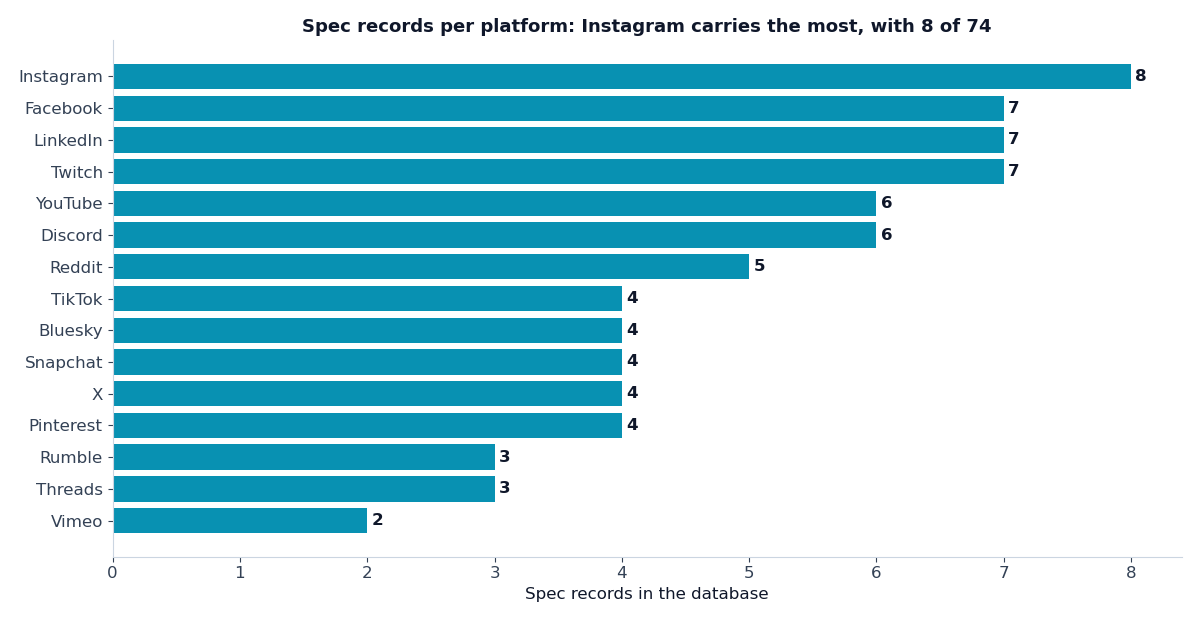
Our database holds 74 spec records across 15 platforms. Instagram carries the most, with 8 distinct placements to verify. Facebook, LinkedIn and Twitch carry 7 each, YouTube and Discord 6, Reddit 5, and TikTok, Bluesky, Snapchat, X and Pinterest 4 each. Rumble and Threads carry 3, and Vimeo 2. A brand active on just the five biggest platforms is already looking at 35 separate specs, and that count assumes one account per platform. Agencies auditing a dozen client accounts are checking hundreds of placements against a moving target.
That spread is why a checklist in a spreadsheet dies within a quarter. The audit tool has to hold the current spec for each placement, flag the assets that miss it, and update quietly when a platform changes a size without announcing it.
The tools that hold up at scale
- Frontify: brand guidelines plus asset specs in one system. The enterprise standard.
- Bynder: digital asset management with spec enforcement on upload.
- Air (air.inc): visual asset library with custom fields for platform specs.
- Brandfolder: organizes assets by placement with version control.
- Canva Brand Kit: locks fonts, colors and logo usage for team designs. The cheapest credible option.
What an audit actually checks
Profile images at correct dimensions, banners inside safe areas, post templates matching current specs, and no stretched or pixelated assets anywhere public. Run it quarterly; platforms change specs without announcements. For agencies, build the audit into client onboarding: screenshot every profile, check every dimension, fix everything in week one.
Before you trust any tool with that job, test its numbers against a source you can inspect. Our spec database search exposes the same 74 records this article counts, platform by platform, and the Story Frame Maker shows the story-format end of the work. The tools above manage the system, but the discipline is a calendar reminder, not software.
How to run the audit in one afternoon
Start with the public face. In our database, 29 of the 74 records are profile, avatar, banner, cover, header or logo placements: the assets a visitor sees before a single post. Screenshot every one of them on every account, on desktop and on a phone, because several banners crop differently between the two. Check each against its published size, and log every miss in one list with the account, the placement and the correct dimension.
Then work through the post templates. Pull the last ten posts per account and compare their exported sizes with the feed, story and video specs for that platform. Templates drift quietly: a designer exports at last year's size for months before anyone notices the crop. Finally, record the gaps honestly. Twenty-six of the 74 records in our database publish no recommended dimension at all, and an audit that guesses those numbers is worse than one that marks them unpublished and moves on. The fix list from one afternoon of this is usually short, unglamorous and entirely mechanical: a banner 200 pixels short, a profile image upscaled from a thumbnail, a story template with text inside the platform's button zone.
That is also the standard to hold the software to. A compliance tool that cannot show you, placement by placement, which of the 74 specs it checked and which it could not, is a dashboard, not an audit. The quarterly rhythm matters more than the brand of tool: specs change without announcements, and the accounts that look sharp are simply the ones somebody rechecked. For a worked example of the checking mindset at the small end, read how this site approaches picking a formatting app without the marketing hype, then scale the same questions up to your account list.
One scope warning before you buy anything. A tool's platform list is its audit list. If it covers the five big networks but not the smaller ones in your mix, those accounts silently leave the audit, and in our database the smaller platforms are not trivial: Discord carries 6 spec records, Reddit 5, and Twitch 7, as many as Facebook. Ask vendors for their placement count per platform and compare it with the table above. A vendor whose numbers match the published specs is selling coverage. A vendor who cannot produce the numbers is selling a logo wall.